HomeCatalog⚙️ DevOps & InfrastructureRedis
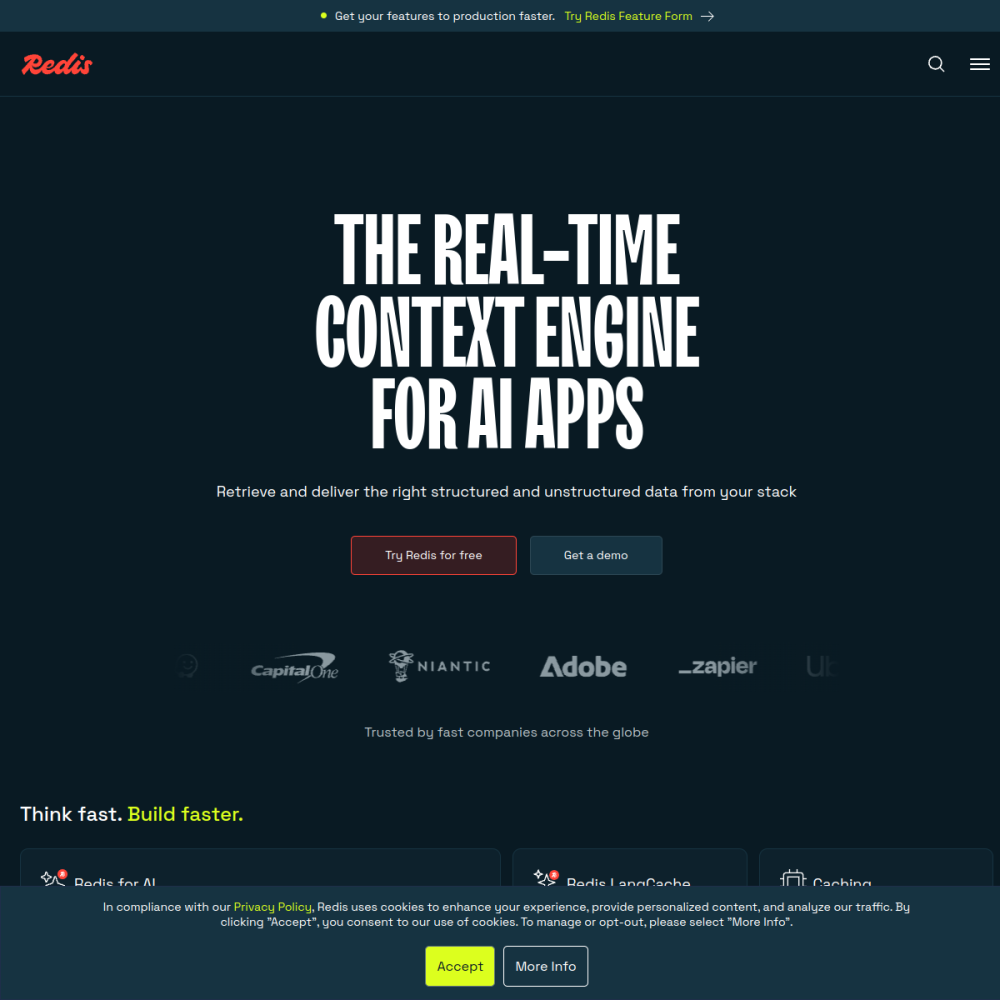
Screenshot of Redis website

// screenshot of redis.io ↗

DEVOPS & INFRASTRUCTURE · FREE TIER

Redisfree

Redis is an in-memory key-value store used as cache, message broker, session store, queue, pub/sub, and primary database. Single-threaded, sub-millisecond latency, with extensive data structures (strings, hashes, lists, sets, sorted sets, streams, bitmaps, HyperLogLog). The default cache layer in modern web architecture.

⚙️ DevOps & Infrastructure Min 256 MB RAM Port 6379 (tcp) Tier free
// What it is

A closer look.

Redis is an in-memory key-value store used as cache, message broker, session store, queue, pub/sub, and primary database. Single-threaded, sub-millisecond latency, with extensive data structures (strings, hashes, lists, sets, sorted sets, streams, bitmaps, HyperLogLog). The default cache layer in modern web architecture.

If your application needs to cache anything or coordinate state, Redis is almost always the answer.

// Use cases

What it's for.

Concrete scenarios where teams pick Redis over the SaaS alternative.

Application cache

speed up DB queries via memoization
Session store

stateless app servers + session in Redis

Job queue

Sidekiq, BullMQ, Celery all use Redis as queue backend

Pub/sub

real-time messaging between services

Rate limiting

counters + atomic increments per user/IP

// Who it's for

Built for these teams.

If your team profile matches one of these, Redis is a strong fit out of the box.

Profile A

Application developers

caching DB queries / sessions

Profile B

DevOps teams

providing Redis as internal service

Profile C

Real-time app builders

using pub/sub for live features

Profile D

Job queue consumers

running async work via Redis queues

Profile E

API developers

implementing rate limiting

// Differentiators

Why teams pick Redis.

When evaluating self-hosted options for this category, here are the dimensions on which Redis consistently lands above the alternatives.

  • BSD-3 (until 2024) — fully open core (post-RSAL license change is debated)
  • Sub-millisecond latency — fastest in-memory store for typical use cases
  • Versatile data structures — beyond key-value to lists/hashes/streams
  • Cluster mode — horizontal scale via sharding
  • Persistence options — RDB snapshots + AOF for durability
  • Vast ecosystem — every framework has a Redis client
// Integrations

Connects to.

The stack you'll plug Redis into — services, protocols, and adjacent apps in the BluixApps catalog.

Application clients
every language (Python, Ruby, Node, Go, Java, .NET, etc.)
Job queues
Sidekiq, BullMQ, Celery, Resque, RQ
Frameworks
Rails, Django, Express, Laravel use Redis for cache
Connection pooling
Redis Cluster Proxy, Twemproxy, RedisRaft
Monitoring
Prometheus redis_exporter, RedisInsight (visual)
Admin tools
redis-cli, RedisInsight, Medis, RedisDesktopManager
Persistence
RDB snapshots + AOF (append-only file)
// Adoption & deployment

Notable users & community

  • 67k+ GitHub stars
  • Used by Twitter, GitHub, Stack Overflow, Snapchat, Pinterest for production caching
  • Backed by Redis Ltd (post-2024 license change drove KeyDB/Valkey forks)
  • Default cache in countless production stacks
  • Massive Stack Overflow / community presence

What we ship

  • Docker compose: Redis single-node
  • Pinned redis:7-alpine (LTS minor version)
  • Password authentication enabled by default
  • Persistent volume at /data for RDB + AOF
  • maxmemory configured to safe default
  • AOF enabled for durability
  • Backup hook covers /data (RDB + AOF files)
// Tips & operations

Run it properly.

Operational guidance from running this in production — what to do before you scale, what to lock down, what surprises people.

// PERFORMANCE
Set maxmemory + eviction policy
without limits, Redis can OOM the host
// SECURITY
Persistence trade-off
RDB = periodic snapshots, AOF = every-write log; pick by durability need
// OPERATIONS
Use connection pooling
short-lived connections add overhead at scale
// RELIABILITY
Watch for the license
post-2024 license is not OSI-approved; Valkey / KeyDB are forks
// DEPLOYMENT
TLS for production
Redis 6+ supports TLS natively
// SCALING
Backup RDB files
periodic dumps; standard file backup works
256
// min ram (MB)
2
// min disk (GB)
6379
// access port
tcp
// protocol
free
// bluixapps tier
6379:6379 · redis:7-alpine
// docker image

Project resources

Official siteredis.io ↗
// Alternatives in DevOps & Infrastructure

Compare with