CatalogStacksModulesSaaSMobileLabs → Become a partner
Home›Catalog›🤖 AI / LLM›Ollama
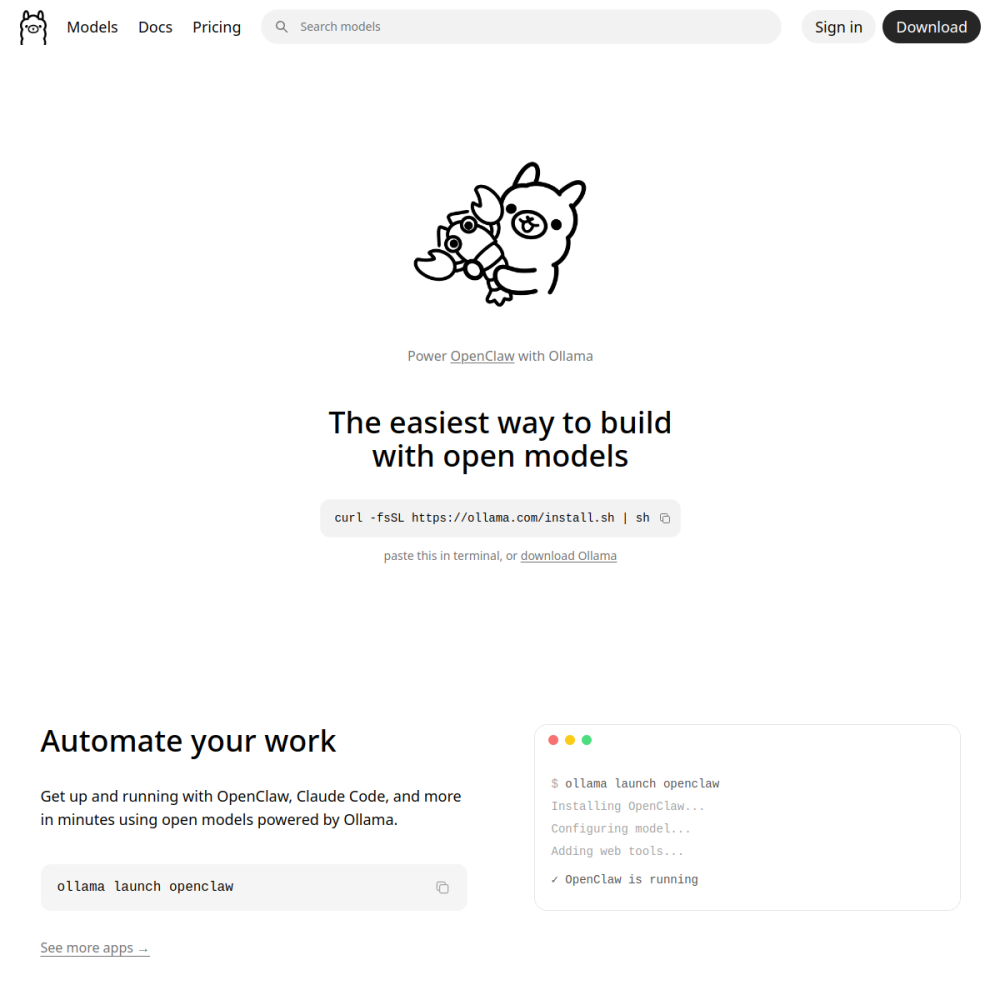
Screenshot of Ollama

// official site: ollama.com ↗

AI / LLM · PRO TIER

Ollamapro

Ollama is the de-facto standard for running local large language models on your own hardware. A single binary + REST API that pulls models from a public registry (Llama 3.3, Mistral, Qwen, DeepSeek, Phi-4 and dozens more), handles quantization, GPU offload, and exposes a simple /api/generate and /api/chat interface that's API-compatible with the OpenAI SDK.

🤖 AI / LLM Min 4096 MB RAM Port 11434 (http) Tier pro
// What it is

A closer look.

Ollama is the de-facto standard for running local large language models on your own hardware. A single binary + REST API that pulls models from a public registry (Llama 3.3, Mistral, Qwen, DeepSeek, Phi-4 and dozens more), handles quantization, GPU offload, and exposes a simple /api/generate and /api/chat interface that's API-compatible with the OpenAI SDK.

It's the boring, reliable engine that every other self-hosted AI tool ends up integrating against — Open WebUI, AnythingLLM, LibreChat, Flowise, LangChain, LiteLLM, n8n.

// Use cases

What it's for.

Concrete scenarios where teams pick Ollama over the SaaS alternative.

◆

Private chat assistants

internal company chat that never sends prompts to OpenAI
◈

GDPR-compliant LLM access

EU customers in healthcare, legal, finance who can't push prompts to US clouds

◇

Cost control at scale

predictable per-month VPS bill vs metered API spend

▣

Air-gapped inference

on-prem or restricted-network environments

▦

AI app development backbone

local dev loop for engineers building on top of LLMs

// Who it's for

Built for these teams.

If your team profile matches one of these, Ollama is a strong fit out of the box.

Profile A

AI developers & ML engineers

fast local dev loop, no API rate limits, no $ per token while building

Profile B

Privacy-bound enterprises

legal, healthcare, finance, gov teams forbidden from US-hosted LLM APIs

Profile C

Hosting providers

resellers offering "private AI VPS" to their customers as a higher-margin SKU

Profile D

Researchers & academics

evaluating open models without paying OpenAI / Anthropic per experiment

Profile E

Indie SaaS founders

predictable per-month VPS cost beats unpredictable per-token bills as traffic grows

// Differentiators

Why teams pick Ollama.

When evaluating self-hosted options for this category, here are the dimensions on which Ollama consistently lands above the alternatives.

  • ✓OpenAI-compatible API — most existing client code works with a URL change
  • ✓Massive model catalog — with one-command pulls (ollama pull llama3.3)
  • ✓Apache 2.0 license — commercial use unencumbered
  • ✓CPU-capable — for small models (TinyLlama, Phi-3) — runs on a $7/mo VPS for testing
  • ✓GPU optional — but supported (CUDA, ROCm, Apple Metal) when you scale to 7B+ models
  • ✓Single binary — operational simplicity, no Python venv hell
// Integrations

Connects to.

The stack you'll plug Ollama into — services, protocols, and adjacent apps in the BluixApps catalog.

◇
Chat UIs
Open WebUI, AnythingLLM, LibreChat, Khoj all detect Ollama as first-class backend
◈
Workflow builders
n8n + Flowise + Langflow + Typebot have native Ollama nodes
◆
LLM SDKs
LangChain, LlamaIndex, Semantic Kernel, Haystack all support Ollama natively
▣
OpenAI-proxy gateways
LiteLLM proxies Ollama as if it were OpenAI for legacy clients
▦
IDE assistants
Continue.dev, Aider, Cline, Cody let devs hit local Ollama for code completion
▩
Model formats
pulls Hugging Face GGUF directly; Modelfile lets you fork & customize
▼
Embeddings endpoint
/api/embeddings works with Chroma, Qdrant, pgvector RAG stacks
// Adoption & deployment

Notable users & community

  • 110k+ GitHub stars, top of awesome-selfhosted AI category
  • Integrated by Continue.dev, Cline, Aider, LangChain, LlamaIndex, LiteLLM, OpenWebUI as a first-class backend
  • Active Discord, weekly model drops, strong macOS and Linux maintainer community
  • Backed by ollama.ai company — sustainable dev model with permissive Apache 2.0 license
  • Cited in countless "self-host your AI stack" guides on r/selfhosted, r/LocalLLaMA

What we ship

  • Docker compose stack: Ollama server + GPU passthrough config (off by default)
  • Pre-allocated model storage volume at /var/lib/ollama for persistence across upgrades
  • Pinned ollama/ollama:0.5.4 image, tracked weekly against upstream
  • HTTP-only by default on 127.0.0.1:11434; SSL + auth via Nginx Proxy Manager when paired with Open WebUI
  • Sizing guidance shipped in customer docs: 8 GB RAM minimum for 3B models, 16 GB recommended for 7B, GPU required for 13B+
  • Backup hook captures /var/lib/ollama before each update (models can be 4-20 GB — opt-in)
// Tips & operations

Run it properly.

Operational guidance from running this in production — what to lock down, what surprises people.

// PERFORMANCE
Pre-pull models
before exposing the service — first request triggers a multi-GB download that times out user calls
// SECURITY
Tune OLLAMA_KEEP_ALIVE
default unloads model after 5 min idle; set 1h for warm latency, -1 to keep forever
// OPERATIONS
Verify GPU detection
with ollama ps — if model says "100% CPU" you're not using your GPU; check NVIDIA drivers + CUDA toolkit
// RELIABILITY
Never expose Ollama directly
no built-in auth; always behind nginx + basic auth, OAuth proxy, or a chat-UI gateway
// DEPLOYMENT
Memory budget rule
7B Q4 ≈ 5 GB, 13B Q4 ≈ 9 GB, 70B Q4 ≈ 40 GB; size VPS accordingly
// SCALING
Disk cleanup
ollama list then ollama rm unused; models silently accumulate in /usr/share/ollama/.ollama/models
4096
// min ram (MB)
20
// min disk (GB)
11434
// access port
http
// protocol
pro
// bluixapps tier

Project resources

Official siteollama.com ↗
↑