HomeCatalog🤖 AI / LLMQdrant
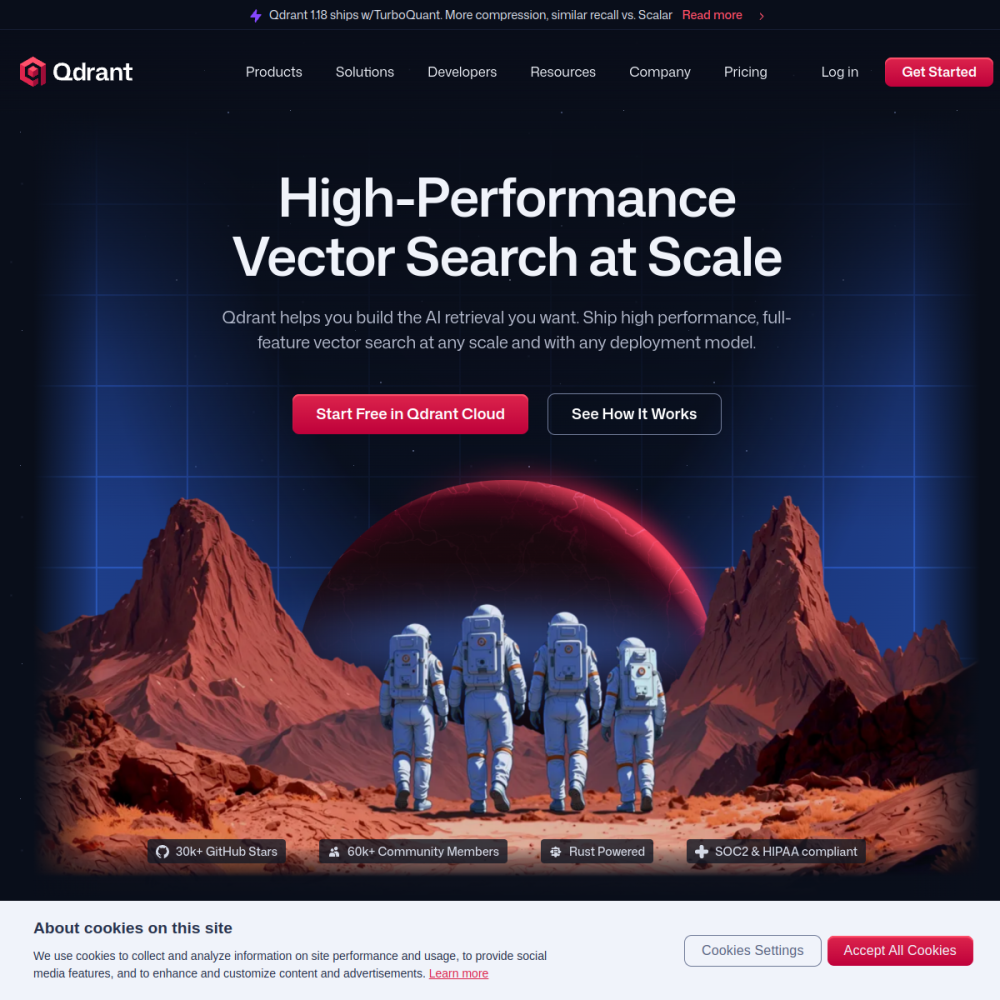
Screenshot of Qdrant website

// screenshot of qdrant.tech ↗

AI / LLM · PRO TIER

Qdrantpro

Qdrant is a high-performance vector database written in Rust, designed for AI-powered search and recommendation at production scale. Open-source (Apache 2.0), single-binary deployment, gRPC + REST APIs, with hybrid (dense + sparse) search, payload filtering, and quantization for memory efficiency.

🤖 AI / LLM Min 1024 MB RAM Port 6333 (http) Tier pro
// What it is

A closer look.

Qdrant is a high-performance vector database written in Rust, designed for AI-powered search and recommendation at production scale. Open-source (Apache 2.0), single-binary deployment, gRPC + REST APIs, with hybrid (dense + sparse) search, payload filtering, and quantization for memory efficiency.

It's the backbone of RAG pipelines that need to scale beyond toy projects — million-vector collections, sub-100ms p99 latencies, horizontal sharding.

// Use cases

What it's for.

Concrete scenarios where teams pick Qdrant over the SaaS alternative.

RAG retrieval at scale

embed your knowledge base, retrieve top-k passages for LLM context
Semantic search

replace keyword search on docs, products, support tickets

Recommendation systems

find similar items, users, content via vector similarity

Multi-modal search

image, text, audio embeddings co-located in one collection

Anomaly detection

outlier detection via vector distance thresholds

// Who it's for

Built for these teams.

If your team profile matches one of these, Qdrant is a strong fit out of the box.

Profile A

AI engineers

building production RAG and semantic search beyond proof-of-concept scale

Profile B

ML platform teams

replacing Pinecone with self-hosted Qdrant for sovereignty + per-month cost predictability

Profile C

E-commerce engineering

powering "find similar items" / personalized recommendations on millions of SKUs

Profile D

Search teams

upgrading keyword-only to hybrid (dense + BM25) for relevance gains without re-indexing

Profile E

Researchers & academics

working with multi-million vector datasets and needing reproducible local infra

// Differentiators

Why teams pick Qdrant.

When evaluating self-hosted options for this category, here are the dimensions on which Qdrant consistently lands above the alternatives.

  • Rust performance — sub-10ms query latency on million-vector collections
  • Hybrid search — dense + sparse (BM25-style) combined natively
  • Payload filtering — pre-filter by metadata before similarity, no Python re-scoring
  • Quantization — INT8 + binary encoding cuts RAM 32× with minimal recall loss
  • First-class clients — Python, JS, Rust, Go, Java, .NET, all type-safe
  • Apache 2.0 — no commercial restrictions
  • Snapshot + restore — built into the binary
// Integrations

Connects to.

The stack you'll plug Qdrant into — services, protocols, and adjacent apps in the BluixApps catalog.

Client libraries
typed SDKs for Python, JS, Rust, Go, Java, .NET, PHP, Ruby
LLM frameworks
LangChain, LlamaIndex, Haystack, Semantic Kernel ship Qdrant adapters
Embedding providers
OpenAI, Cohere, Hugging Face, sentence-transformers, FastEmbed (built into Qdrant)
Streaming ingestion
Apache Kafka / Pulsar via custom workers
Backup
snapshot to local disk or S3-compatible object storage
Observability
Prometheus metrics endpoint, distributed tracing via OpenTelemetry
Protocols
gRPC (fast) + REST (universal); both auth-protected with API key
// Adoption & deployment

Notable users & community

  • 20k+ GitHub stars
  • Used by Disney, Visa, Bayer, X (Twitter), and many AI startups for production retrieval
  • Strong Discord, monthly community calls, active engineering blog
  • Common pairing with Flowise, AnythingLLM, n8n in self-hosted AI stacks
  • Backed by Qdrant company (DE-based) — strong European OSS company with sustainable open-core model

What we ship

  • Docker compose: Qdrant single-node (cluster mode available for Enterprise tier)
  • Pinned qdrant/qdrant:v1.13.0, weekly upstream tracking
  • API key auth enabled by default (random key shown in install report)
  • Persistent storage volume at /qdrant/storage for collections + snapshots
  • gRPC + REST both exposed; HTTPS via Let's Encrypt on REST endpoint
  • Pairs naturally with Flowise / AnythingLLM / n8n on same VPS for one-click RAG stack
  • Backup hook captures storage volume + snapshot exports
// Tips & operations

Run it properly.

Operational guidance from running this in production — what to do before you scale, what to lock down, what surprises people.

// PERFORMANCE
Enable quantization
quantization_config.scalar.type=int8 cuts RAM 4×, binary cuts 32× with <2% recall loss
// SECURITY
Create payload indexes before bulk insert
create_payload_index on filter fields speeds queries 10× post-insert
// OPERATIONS
Run with replicas=2
even on a single VPS — protects against snapshot/data corruption without cross-node setup
// RELIABILITY
Snapshot weekly to S3
built-in /snapshots endpoint + cron + S3 upload = cheap off-site backup
// DEPLOYMENT
Use FastEmbed for built-in embedding
runs inside Qdrant; saves an external OpenAI Embeddings API round-trip
// SCALING
Mind sharding above 10M vectors
single collection limits exist; design with shard_number from the start
1024
// min ram (MB)
5
// min disk (GB)
6333
// access port
http
// protocol
pro
// bluixapps tier
6333:6333 · qdrant/qdrant:latest
// docker image

Project resources

Official siteqdrant.tech ↗
// Alternatives in AI / LLM

Compare with